There’s nothing quite like the sudden, unsettling silence of a power outage to remind you just how dependent we are on electricity. From keeping your food cold to powering critical medical equipment, maintaining comfort, and even staying connected, a reliable backup power source is more than a luxury—it’s peace of mind. But before you rush out to buy the biggest generator on the market, understanding proper Generator Sizing and Home Power Requirements is the single most critical step to ensuring your investment truly pays off when the lights go out.
Underestimate your needs, and you'll find your generator sputtering, tripping, or simply failing to power the essentials, leaving you in the dark exactly when you need it most. Overshoot, and you're pouring money into excess capacity, higher fuel bills, and unnecessary maintenance. This isn't just about watts; it's about smart resilience.
At a Glance: Your Generator Sizing Essentials
- Don't Guess, Calculate: List every essential item you need powered during an outage.
- Running vs. Starting Watts: Distinguish between continuous power needs and the surge required for motors to kick on.
- Safety Margin is Key: Always add 25-30% to your total calculated wattage for reliability and future needs.
- Portable or Standby? Your lifestyle and budget will dictate the best type for your home.
- Fuel Matters: Consider availability, storage, cost, and efficiency when choosing.
- Installation is Critical: A transfer switch is non-negotiable for safety and compliance.
Why Generator Sizing Isn't a Guessing Game
Imagine buying a car only to find it stalls on every hill, or a backpack that barely holds your keys. That's what an undersized generator feels like during a blackout. It simply can't handle the load, leading to frustrating power failures, appliance damage, and even safety hazards like overheating circuits. You might get power to one light, but your refrigerator could cycle off, your furnace blower might refuse to start, or your well pump could burn out trying to draw insufficient power.
On the flip side, an oversized generator is like driving a semi-truck to pick up groceries. It's overkill. You'll spend more upfront, burn significantly more fuel than necessary (even when running at a fraction of its capacity), and potentially face increased maintenance costs. Proper sizing ensures your home receives adequate, stable power without wasting resources, maintaining comfort, and extending the life of both your generator and your appliances. It's a sweet spot between efficiency, safety, and unwavering reliability.
Demystifying Your Home's Power Needs: The Wattage Walkthrough
Calculating your home's power requirements might sound daunting, but it's a straightforward process when broken down. Think of it as creating a power budget.
Step 1: Inventory Your Essentials (and Nice-to-Haves)
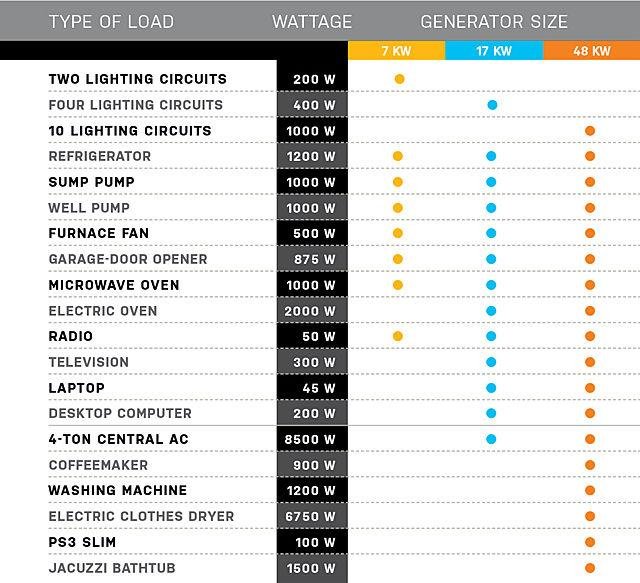
Before you can add anything up, you need to know what you want to power. Grab a pen and paper or open a spreadsheet. Walk through your house and list every appliance, light fixture, HVAC component, and electronic device you absolutely cannot live without during an extended outage.
Start with the absolute critical items:
- Refrigerator/Freezer
- Well Pump (if applicable)
- Furnace Blower (for heat)
- Key Lights (at least one per living area, bathroom)
- Garage Door Opener
- Sump Pump
- Medical devices (CPAP, oxygen concentrator)
- Phone charging, internet router
Then, consider comfort and convenience: - Television/Entertainment system
- Microwave
- Small kitchen appliances (coffee maker)
- Central Air Conditioning (a big power hog!)
- Electric water heater (another big one)
- Laundry machines
For each item, you’ll need its wattage. You can usually find this on a label on the appliance itself, in the owner's manual, or by doing a quick online search for the specific model.
Step 2: Adding Up the "Running Watts"
Most appliances have a "running wattage" (or continuous wattage) listed. This is the power they constantly draw while operating normally. For your list, sum up the running watts for all the items you intend to power simultaneously during an outage.
Let's say your essential list includes:
- Refrigerator: 600 running watts
- Furnace Blower: 800 running watts
- Well Pump: 1,000 running watts
- Several lights: 500 running watts (total)
- TV & Internet Router: 300 running watts
Total Running Watts = 600 + 800 + 1000 + 500 + 300 = 3,200 watts
This is your baseline, but it's not the whole story.
Step 3: Conquering "Starting Watts" (The Surge Superpower)
Many appliances, especially those with electric motors (refrigerators, freezers, AC units, well pumps, furnace blowers), require a momentary burst of extra power to start up. This is called "starting watts" or "surge watts," and it can be 2-3 times higher than their running wattage.
Here's the trick: your generator only needs to handle one starting wattage surge at a time, specifically the highest one. Appliances typically don't all start simultaneously.
Go back to your list and identify items with motors. Find their starting wattage. If it's not listed, a common multiplier is 2x-3x the running watts.
- Refrigerator: 600 running watts, let's estimate 1800 starting watts (3x)
- Furnace Blower: 800 running watts, estimate 2400 starting watts (3x)
- Well Pump: 1000 running watts, estimate 3000 starting watts (3x)
In this example, the Well Pump has the highest starting wattage at 3,000 watts.
Now, add this single highest starting wattage to your total running watts:
Total Watts Needed (before safety margin) = Total Running Watts + Highest Starting Watts
Total Watts Needed = 3,200 watts + 3,000 watts = 6,200 watts
This 6,200 watts represents the peak power your generator will need to provide at any given moment.
Step 4: The All-Important Safety Margin
You've calculated your peak demand, but you're not done yet. To account for fluctuations in power quality, the possibility of adding another small appliance later, or simply ensuring your generator isn't constantly running at its absolute maximum capacity (which can shorten its lifespan), you must add a safety margin.
A good rule of thumb is to multiply your total calculated wattage by at least 1.25 (a 25% safety margin) or even 1.30 (30%).
Minimum Generator Capacity = Total Watts Needed x Safety Margin
Minimum Generator Capacity = 6,200 watts x 1.25 = 7,750 watts
So, for this example, you'd be looking for a generator with a minimum capacity of 7,750 watts (or 7.75 kW). Round up to the nearest common generator size (e.g., an 8,000-watt or 9,500-watt unit).
Sizing Scenarios: What Does 5kW, 15kW, or 25kW Really Get You?
To make this more concrete, let's look at common scenarios:
- Basic Emergency Essentials (5,000 – 7,000 watts / 5-7kW): This range is perfect for keeping critical items running. Think refrigerator, a few lights, furnace blower, phone charging, and a TV. This ensures food safety, basic comfort, and communication. A typical home refrigerator, for example, consumes 300 to 800 running watts. This size is often achievable with a robust portable generator.
- Comfort-Focused Backup (10,000 – 15,000 watts / 10-15kW): Stepping up, you can add more amenities. This might include a microwave, a dedicated freezer, most household lighting, and perhaps even a smaller central air conditioning unit or electric water heater if managed carefully (meaning you wouldn't run everything at once). This size often marks the entry point for smaller standby generators.
- Whole-Home Power & Luxury (15,000 – 25,000+ watts / 15-25kW+): If you want to maintain near-normal living during an outage, including central air conditioning (which alone can add 3,000-5,000+ running watts, plus a massive starting surge) and multiple large appliances simultaneously, you'll need a substantial generator. This is typically the realm of large standby generators, like permanently-installed air-cooled units that range from 13-20 kW or liquid-cooled models that can go from 25-150 kW. Running an entire house, including AC, generally requires a generator in the 15-25kW+ range.
Choosing Your Power Partner: Portable vs. Standby
Once you know your wattage needs, the next big decision is the type of generator. Each offers distinct advantages and disadvantages, catering to different budgets and convenience preferences. For a more granular breakdown, you can explore a detailed comparison of portable and standby generators.
Portable Power: Flexibility on the Go
Portable generators are popular for their lower upfront cost and versatility. They're designed to be moved, making them suitable for home backup, tailgating, or job sites.
- Pros:
- Lower Initial Cost: Generally much cheaper to purchase than standby units.
- Flexibility: Can be used for various purposes beyond home backup.
- Manual Control: You decide what to plug in and when.
- Fuel Versatility: Many models are "dual fuel," running on gasoline or propane. Heavy-duty, gasoline- or propane-powered 9,500-watt dual fuel portable generators are readily available.
- Cons:
- Manual Operation: Requires manual startup, fueling, and connecting appliances via extension cords.
- Fuel Storage: Requires storing gasoline or propane, which can degrade or pose safety risks.
- Limited Capacity: While powerful models exist, they generally can't power an entire large home with central air conditioning as easily as a standby unit.
- Placement & Safety: Must be operated outdoors, away from windows and doors, to prevent carbon monoxide poisoning. Requires careful management of extension cords.
Standby Systems: Set-It-and-Forget-It Reliability
Standby generators are permanently installed outside your home, much like an AC unit. They automatically kick in moments after a power outage, providing seamless backup.
- Pros:
- Automatic Operation: Detects outages and starts automatically, even when you're not home.
- Whole-Home Power: Capable of powering entire homes, including central AC and major appliances.
- Direct Connection: Connects directly to your home's electrical system via a transfer switch, powering hardwired appliances without extension cords.
- Fuel Efficiency/Convenience: Often connected to natural gas or a large propane tank, offering a continuous fuel supply without manual refueling.
- Cons:
- Higher Initial Cost: Significantly more expensive to purchase and install.
- Professional Installation: Requires expert installation by licensed electricians and gas plumbers.
- Less Flexible: Fixed in place, solely for home backup.
- Maintenance: Requires regular professional servicing to ensure readiness. Cummins, for example, offers robust standby generators ranging from air-cooled (13-20 kW) to liquid-cooled (25-150 kW).
Fueling Your Resilience: A Look at Generator Fuel Types
The fuel your generator runs on significantly impacts its performance, operating costs, and convenience.
- Gasoline:
- Pros: Widely available at any gas station.
- Cons: Shorter shelf life (can degrade in a few months), emits more pollutants, requires frequent refueling for portable units, can be dangerous to store in large quantities.
- Propane:
- Pros: Stores longer than gasoline without degrading, burns cleaner, safer to store in tanks, readily available in cylinders for portables or large tanks for standby.
- Cons: Provides slightly less power per gallon than gasoline, requires more fuel for the same output, propane standby generators require a dedicated tank installation.
- Diesel:
- Pros: Very efficient and reliable, fuel stores well, commonly used in commercial and large-scale generators.
- Cons: Generators are typically more expensive to purchase, diesel fuel can "gel" in extremely cold temperatures, specific storage requirements.
- Natural Gas:
- Pros: Unlimited fuel supply (as long as your utility line is intact), no need for onsite fuel storage, burns very cleanly, extremely convenient for standby units.
- Cons: Requires professional installation of a gas line to the generator, dependency on the natural gas utility (if the line goes down, so does your generator).
Considering safe fuel storage practices is paramount, especially for gasoline and propane, to prevent accidents and ensure your fuel supply is ready when needed.
Safety First: Essential Installation & Operation Considerations
Regardless of your generator type, safety should always be your top priority. Accidents, especially carbon monoxide poisoning and electrical hazards, are preventable with proper installation and adherence to guidelines.
The Critical Role of the Transfer Switch
This cannot be stressed enough: a transfer switch is required by electrical code to safely connect a generator to your home's electrical system. This device is the linchpin of safe generator operation. It prevents dangerous "backfeeding" of electricity from your generator into the utility lines. Backfeeding can seriously injure or even kill utility workers trying to restore power, and it can also damage your generator or home's electrical system.
- Manual Transfer Switches: More affordable, you manually switch your home's power source from utility to generator (and vice-versa) during an outage.
- Automatic Transfer Switches (ATS): Essential for standby generators, they automatically detect an outage, start the generator, and switch your home's power source without any manual intervention. This offers maximum convenience and safety.
Understanding a deeper dive into transfer switches will reveal how this vital component acts as a gatekeeper, ensuring your home's power is isolated from the grid during operation. For a full guide on physically safely connecting a generator to your home's electrical system, consult professional resources and always prioritize licensed installation.
Other Key Safety Points:
- Outdoor Operation Only: Never run a generator indoors, in a garage, carport, or near open windows. Carbon monoxide is an odorless, colorless, deadly gas.
- Placement: Position the generator on a level surface at least 10-20 feet away from your home, with the exhaust pointed away from living spaces.
- Carbon Monoxide Detectors: Install CO detectors with battery backup in your home, especially near sleeping areas.
- Proper Maintenance: Just like your car, your generator needs regular checks and servicing to ensure it runs reliably and safely. Adhering to manufacturer guidelines for essential generator maintenance is crucial for longer run times and to avoid preventable hazards.
The Dollars and Cents: Understanding Generator Costs
Investing in a generator is a significant decision, and understanding the full cost picture is vital. This includes not just the purchase price but also installation and ongoing operating expenses.
Upfront Purchase Price
- Portable Generators: Generally range from a few hundred dollars for smaller units to $2,500 - $5,000+ for heavy-duty, high-wattage dual-fuel models.
- Standby Generators: These are a more substantial investment, typically ranging from $5,000 to $20,000+ for the unit itself, depending on size (kW) and features. Large whole-home units can go much higher.
Installation Costs
This is where standby generators incur significant additional expense. Professional installation for a standby unit can easily add $3,000 to $10,000+ to the total cost. This includes:
- Electrical Work: Installing the transfer switch, wiring the generator to your home's electrical panel.
- Fuel Line Installation: For natural gas or a large propane tank.
- Concrete Pad: A level, stable base for the generator.
- Permits: Local permits are almost always required.
Portable generators, while requiring manual connection, still benefit greatly from a professionally installed transfer switch and dedicated outdoor outlet, which can add $800 to $2,500 depending on complexity.
Operating Costs
Once installed, your generator needs fuel. These costs vary wildly based on:
- Generator Size and Load: A larger generator powering more items will burn more fuel.
- Fuel Type: Natural gas is often the cheapest per therm, followed by propane, then gasoline. Diesel can be more variable.
- Efficiency: Newer inverter generators and highly efficient standby units will consume less fuel.
- Local Fuel Prices: These fluctuate based on market conditions.
For context, gasoline generators typically cost between $2 to $8 per hour to operate, with the range depending heavily on their size and the electrical load they're supporting. Standby units on natural gas can be significantly cheaper per hour if the gas line is already present.
Making the Smart Purchase: Where and How to Buy
You've done the calculations, you understand the types, and you've budgeted. Now, where do you buy?
- Trusted Local Dealer: This is often the best route for standby generators. A local dealer can offer:
- Expert Consultation: They'll help you finalize your sizing calculations and recommend the best model for your specific needs.
- Professional Installation & Service: They typically handle the entire installation process and provide ongoing maintenance, offering a single point of contact for everything.
- Local Support: Easier to get assistance with warranty claims or emergency repairs.
- Online Retailers: A popular option for portable generators.
- Wider Selection: Often have a broader range of brands and models.
- Competitive Pricing: Can sometimes find better deals, especially during sales.
- DIY or Separate Installation: You'll need to handle the sizing yourself, arrange for shipping, and then either manage the installation (for portable) or hire a licensed electrician and gas plumber separately (for standby).
Many reputable brands also offer online generator sizing calculators, which can be a helpful tool to double-check your own estimations. However, a final consultation with an authorized dealer or a licensed electrician is always recommended to ensure accuracy and compliance with local codes.
Your Next Step to Outage Protection
The peace of mind that comes with knowing you’re prepared for a power outage is invaluable. By taking the time to accurately calculate your generator sizing and understand your home's specific power requirements, you're not just buying a machine; you're investing in uninterrupted comfort, safety, and security for your household.
Start by auditing your home's essential loads, add up those watts, apply the safety margin, and then explore the generator types and fuel options that align with your lifestyle and budget. Don't let a blackout catch you off guard again. Empower yourself with knowledge, make an informed decision, and ensure your home remains a beacon of light when the neighborhood goes dark.